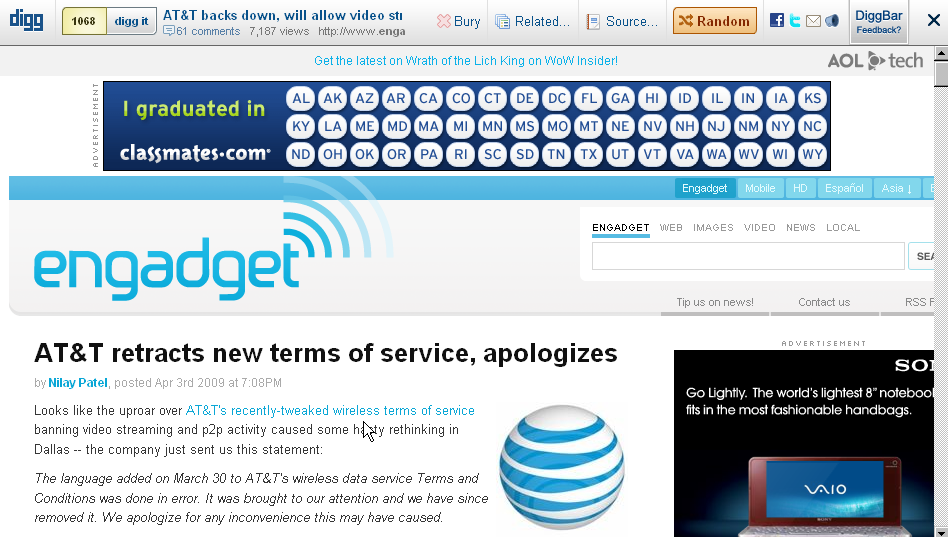
In the past year or so, a number of social news, networking and community sites have implemented faux toolbars which appear at the top of your browser pane. They seek to extend the original site’s functionality to the rest of the web. They usually frame the page, so that your address bar displays a different (often shortened) URL than the page’s original one. There are plenty of examples already–Digg (here’s a screenshot of that one in action), Reddit, StumbleUpon, Facebook, HootSuite. There’s even a WordPress plugin that enables anybody to create such a framing bar for their own blog.
I’m not a fan of these tools. There are plenty of critiques around the web (here’s one on the DiggBar), but my particular complaint is that often the first thing I want to do when I visit a page is copy the URL (to email, blog about, tweet about, and so forth). These bars prevent me from accessing the page’s actual URL. Plus, I think it’s an incredibly tacky attempt at brand extension, and they’re taking valuable real estate away from the site they’re framing. Er, okay, slight rehash.
There are code samples (that’s the first Wikipedia article I’ve ever nominated for deletion) which enable me to prevent the bar from appearing on sites I own. That’s not really the problem I’m trying to solve though.
I was complaining about this on Twitter last night, and this little discussion ensued (er, that’s in reverse order):


Here’s the problem with opt-out: I need to do it on a case-by-case basis. I know I’m an outlier, but I use two computers, and run two different browsers on each computer. Assuming there are just six of these bars I have to deal with, that’s 24 opt-outs. Assuming the trend continues, that number could easily become 50 or 100.
But there’s a simple solution. Set some industry standards around these framing bars that enable me–using a Greasemonkey script, plugin or browser setting–to opt out for all the bars at once. It’s not, for example, that dissimilar from turning off javascript or the auto-completion of forms. This would prove a much more customer-oriented solution to the problem than forcing users to turn the bars off on a case by case basis.
Or maybe such a script already exists, and I just missed it in my searches?
 DarrenBarefoot.com
I think that’s a great idea. We’ll look at an opt our of all bars option. There *may* be a way we can set cookies to opt out of all. FYI the link I was referencing is http://ow.ly/socialbar
Our findings show that its a low % of users who dont like the bar and its typically people within our industry who feel the same way you do. However the vast majority of the ow.ly social bar users find value and utility in it. We feel we’ve created a useful tool and here’s a bit of info on it: http://ow.ly/socialbar
On the topic of opt-out, we cant be responsible for the practices of others but have made it incredibly easy for anybody viewing an ow.ly link to remove the bar. In the case of 99% of users of our tool this is perfectly acceptable.
That said, with such a low % of users having issue it’s likely more trouble than its worth to create a standard for people to adhere to for removal of the bar.
Dario: Thanks for your comments. In truth, HootSuite’s offering vis-a-vis the bar is a little different than the other tools. In your case, it’s really framed as a feature, and (at least to my thinking) a key aspect of your product. So it’s not surprising that your users–who have adopted the product already knowing about the bar–don’t object to it.
That differs, I think, from the vast majority of bar implementations, which are tacked on as new (and sometimes surprising) functionality from existing sites.
This won’t work the way you’ve framed it. But I actually think it should go the other way – put the power into the hands of the publishers as well.
Rather than having HootSuite, Digg, etc. etc. do a frame implementation, a publisher could embed Javascript on their page that did the same thing (much like Digg widgets, just with expanded functionality).
But they could choose to embed it, and probably get some direct analytics from it. Users could still opt out, or the publisher could *choose* to not use it on a particular page.
Personally, as heavy web surfer/power user/linker/blogger/whatever you want to call me, I find no use for these bars whatsoever. And it’s telling that, so far, the only people I’ve seen defending the toolbars during these controversies are people affiliated with the sites that generate them, i.e. those who have something to gain from them.
For the most part, we users have little or nothing to gain, and lots to lose to inconvenience and confusion.
I use Digg sparingly, for instance, and if I want to Digg something, I’ll do it at the site. If I create a link on Facebook, I want people to go to the page, not a framed linkbar version of the page. If I use a shortened URL (which I only do on Twitter, since it’s necessary there), I want to create one that redirects cleanly, not with a linkbar, and if I click one, I want it to provide me the same courtesy.
The thing with all these bars is that they should not be opt-out. They should be opt-in. For the user. Maybe even for the target site maintainer. (I currently have a script that automatically kills the Diggbar for people visiting my blog, and may soon install a more universal one for any incoming link that shows my site to people in a frame.)
It’s fine that ow.ly gives users a one-time opt-out, as far as it goes. But that’s like each individual junk mail sender saying I can opt out of their junk mail — it puts a big load on me to get rid of something I never wanted or asked for.
Plus it’s not really one-time. It’s once per user, per browser, per computer, as long as you maintain your cookies. If I’m on another computer in my house, or a public machine, or I use another browser or another user account, or a mobile device, or clear my cookies, or reinstall stuff, I have to opt out again, for that one service. And again for other services, playing whack-a-mole whenever I encounter such a bar.
And I do: my first task when I encounter a framed toolbar from any link is to kill the bar, before I look at the content of the page, because (a) I have yet to find a toolbar that gives me any features I want, and (b) too often I’ve had the bars screw up navigation, so if I click links within the framed page, then kill the bar, I go back to some previous page rather than the one I want. Oh, and I can’t see the real URL I want to copy to make a link.
Less obsessed users than me might not care, or notice, but I notice for them, because then they send me links that don’t go to the original site, but to a linkbarred version.
So the only thing these toolbars have done for me, since About.com and others introduced them years ago, is piss me off. And they’re doing that more and more. For me, they offer a guise of being helpful while really being corrosive to the Web’s usability, to benefit the bar-generating company or organization instead of me. They are, to my mind, a step back, and a trend that deserves to go away.
I’ll do my best to hasten that process.
This is the same issue that arose about 14 years ago when Netscape introduced frames. Jakob Nielsen names it the #1 problem in “Top Ten Web Design Mistakes of 1996”: http://www.useit.com/alertbox/9605a.html
Now the web is being built by these young punks who were in kindergarten in 1996 and wouldn’t know Jakob Nielsen from any other Dane with long sideburns. We, the thirtysomethings, the elder statemen of the web, must remind our young brethren of the historical lessons learned.
The solution is simple. Bring back .
🙂
(that was supposed to be the “marquee” tag)
You so old, your tag has been deprecated.