Shakespeare’s Theatre Found Amongst Flurry of Confusing Headlines

March 9th, 2009, No Comments »

Today I followed a link and found this story on the BBC website. It’s entitled “Shakespeare’s first theatre found”, and refers to the discovery of the remains of the confusingly-named Theatre, the first theatre in which Shakespeare acted and his plays were performed.

That seemed vaguely familiar to me. Scanning the article, I spotted another headline in the ‘See Also’ section of the sidebar:
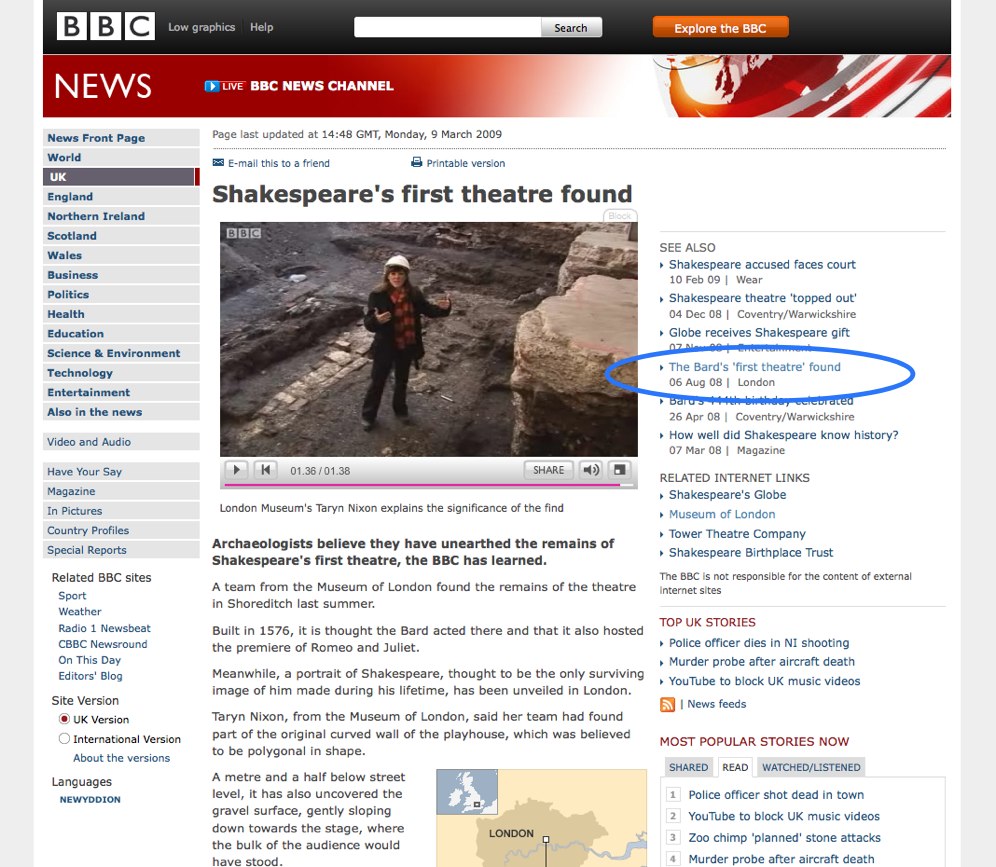
BBC NEWS | UK | Shakespeare's first theatre found

That article, from last August, is called “The Bard’s ‘first theatre’ found”. That’s actually when the discovery was announced by a team from the Museum of London. You can read the original Museum of London press release, and today’s subsequent one that spawned the confusing headline. Maybe the BBC needs some kind of “check for duplicate heading” functionality in their content management system?

To make matters worse, the Daily Mail used the headline “Remains of Shakespeare’s first Globe Theatre unearthed in East London”. This is technically accurate, but deeply misleading. In 1599, the Globe Theatre was built with timber from the aforementioned Theatre. The Mail used that headline despite the discovery having been made six months ago, and the Theatre only being tangentially related to the Globe.

And, since I’m being all nitpicky, why does London Museum’s Taryn Nixon refer to The Theatre as “probably the second theatre ever built”? in the video associated with today’s article? What about all those Greek and Roman theatres? Maybe she means “the second theatre ever built in London”?

From a theatre history perspective, this is a really important find. It is, for example, almost certainly where “Romeo and Juliet” was first performed. Appropriately, the Tower Theatre Company plans to build a new theatre on the site.

No Comments »

Globe Theatres: Past, Present and Virtual

September 29th, 2008, No Comments »

In several recent talks, I’ve opened with a story about the De Witt sketch. It’s a depiction, in 1596, of the stage of London’s Swan Theatre. It is, for all intents and purposes, the only image that theatre historians have that shows the interior of an Elizabethan theatre. It’s the best picture we have of the stages that Shakespeare acted upon and for which he wrote.

De Witt Sketch, Swan Theatre

The man who drew the sketch was Johannes De Witt, a Dutch visitor to London who recorded his observations in his journals. In fact, De Witt’s original sketch is lost. The ‘De Witt’ sketch is actually a copy by fellow Dutchman, Arendt van Buchell.

Then I show photos of the Globe Theatre (here’s a big panorama of the interior), a present-day replica that sits on the Thames river, very close to its original location. For theatre and history buffs it’s a real pleasure to stand inside this space, which is reknowned for its historical accuracy. In fact, if theatre historians discover new information about the Globe, they modify the building to match .

Then in my talk I jump to images of the New Globe Theatre in Second Life. It’s a model of a proposed actual theatre on Governor’s Island in New York. It doesn’t look much like the original or the replica, but I like the connection of the past to the future, and of the actual to the virtual. I then make some connections to De Witt’s sketch as user-generated content, his journal as a blog and Arendt’s copy as a copyright violation. And things roll on from there.

That’s a long-winded introduction to say that somebody recently emailed me with a link to an actual, apparently accurate replica of the Globe Theatre. This appears to be a sort of showcase piece for a Second Life architect named Ina Centaur. It’s a pretty impressive accomplishment, and will make for a smoother metaphor in future talks.

No Comments »

44 Fascinating Things You Probably Don’t Know About Shakespeare

January 4th, 2008, 13 Comments »

I recently finished Peter Ackroyd’s 592-page biography of William Shakespeare. I won’t lie to you–it was a bit of a slog. Ackroyd doesn’t leave anything out. Plus there’s plenty of speculation, because the world doesn’t have 592 pages worth of facts about ol’ Bill. Plus, all the quotations from the plays are in the original Early Modern English, which makes reading them a little trickier.

That said, I enjoyed the biographer for the complete portrait it drew of our greatest English-language writer. As an exercise in, uh, active-reading, I made a list of interesting facts about The Bard, most of which I didn’t know.

Here they are for your perusal. My favourites are #2, #11 and #26.

Early Life

  1. One of the schools which Shakespeare attended is still in operation.
  2. At the age of 18, Shakespeare may have worked in the office of Henry Rogers, the town clerk of Stratford. While working there, he would have become familiar with the case of a young woman who drowned in the Avon river, in a stretch known for its overhanging willow trees and coronet weeds. The case revolved around whether the woman had fallen into the river accidentally, or had committed suicide. Rogers completed an inquest, and found the former to be true. The young woman, named Katherine Hamlett, could therefore have a Christian burial.
  3. Shakespeare’s father was a glove maker, a land speculator (with mixed results) and probably a secret Catholic.
  4. Shakespeare was only 18 when he got married. His new wife was 26. All of the manipulative older women in his plays don’t reflect very well on Anne.
  5. Anne was four months pregnant when the couple got married. In truth, this wasn’t particularly unusual. Cohabitation was common before marriage in Elizabethan England, and 20 to 30% of babies were born within the first eight months of wedlock.

Read more…

13 Comments »

Hamlet on YouTube

July 25th, 2007, 5 Comments »

I was looking at something on YouTube the other day (maybe it was this animated project from Bud.TV), and noticed a so-called “Director Video” (I gather these are pay-for-placement) featuring an 18-year-old doing a monologue (not “To Be Or Not To Be”, to his credit) from Hamlet, apparently in a vacant lot:

He’s certainly givin’ ‘er, isn’t he? He’s got plenty of passion and enthusiasm, which is great. And he’s got the thing down, memorization-wise.

What the Words Mean

I’m no Shakespearean performance expert, but this piece highlights a really common difficulty in performing the Bard’s work: you can’t do a great job if you don’t understand the words. All the words. And not just what they mean, or meant in the 16th century, but also some context for their usage. A ‘fishmonger’ isn’t just a guy who hocks cod–it’s also a slang term for ‘pimp’.

Anyhow, I’m not picking on this kid–he seems to have the heart and spirit. You can probably teach the rest.

I did get to thinking about what other Hamlet-related videos I could find on the Tube.

As you might expect, there are many earnest, exceedingly-awful recitations of monologues. I’ll spare you those, but here’s a top tip to aspiring thesbians: memorize the speech instead of reading it off your screen. Here are some of the more interesting videos I found:

The wonderful (if overly fey) Derek Jacobi, along with Patrick Stewart as Claudius:

I’d forgotten all about Cat Head Theatre:

“Hamlet the Musical”, from Gilligan’s Island. That’s truly priceless: “From Ophelia, no one can steal ya, you’ll always be my own”.

And finally, here’s one young actor who’s got her lines down:

Here’s another one along similar lines, this time featuring sixth graders.

5 Comments »